
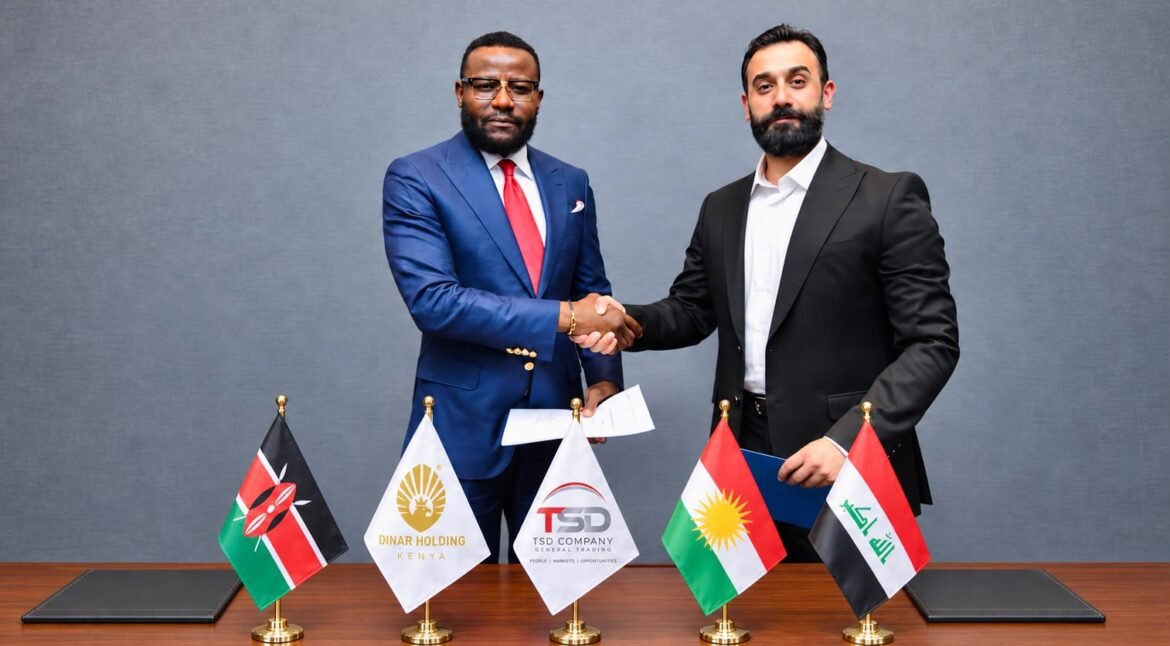
Dinar Holding Kenya Limited has signed a strategic business partnership with Iraq’s TSD General Trading Limited, extending a commercial relationship developed in Türkiye into Kenya as the Iraqi company begins exploring trade, investment and project opportunities in Africa.
The agreement was signed in Nairobi following a market visit by a TSD delegation led by Chief Executive Officer Mr Dali Bede, alongside Mr Bizhar Rekani and Mr Ako Ibrahim, both of TSD General Trading Limited.
The partnership builds on an established relationship between TSD and the wider Dinar Holding Group in Türkiye, expanding that cooperation into Kenya with a broader commercial focus spanning trade, agriculture and agribusiness, energy, infrastructure rehabilitation and development, engineering and construction, manufacturing, distribution and strategic investment.
The business partnership agreement provides a long-term framework through which the companies can identify and pursue commercial opportunities in Kenya, Iraq and other markets. It provides for cooperation across agribusiness, trade, import and export, investment, distribution, manufacturing and services, alongside other commercial activities agreed by the parties.
TSD is an Iraqi general trading company supplying construction and electrical materials, mechanical products and chemical products, alongside engineering and construction solutions for commercial and industrial clients.
Agricultural commodities including avocados, meat, coffee and tea are among the immediate areas of interest, but the Nairobi partnership is intended to extend considerably beyond commodity trading. TSD is also assessing opportunities in energy, infrastructure rehabilitation and development, engineering, construction, industrial development and other strategic investments as part of its longer-term approach to Africa.
During the visit, the delegation engaged with Kenyan businesses and inspected coffee processing operations, avocado facilities and slaughterhouses, examining production capacity, processing standards, supply consistency and export readiness. The programme allowed TSD to assess the commercial requirements for developing recurring supply into Iraq rather than approaching the market through isolated transactions.
The commercial relationship between Kenya and Iraq remains modest. Kenya exported goods worth approximately US$8.96 million to Iraq in 2024, with plants and flowers, fruit, coffee, tea and spices accounting for most of the trade.
H.E. Sultan Ahmed Ali Dinar, Founder and Chairman of Dinar Holding Group and Dinar Holding Kenya, said the relatively small trading base pointed to an opportunity to develop commercial relationships in markets that have traditionally received less attention from African businesses.
“Some of Africa’s next important commercial relationships will be built in markets that have not traditionally been at the centre of African trade,” he said. “Iraq is one of those markets. The opportunity is not to turn away from established trading partners, but to widen the commercial map and create credible routes into markets where African products, companies and investment opportunities are still underrepresented.”
Mr Bede said Kenya offered TSD the right environment from which to begin that process.
“That is one of the reasons we chose Kenya as the starting point. We are not looking at Africa as a single transaction or a single sector. We are looking at where TSD can establish commercially sound relationships that can grow from trade into project development and investment. Kenya gives us access to capable businesses, regional markets and sectors where we believe our experience can add value.”
The private-sector initiative comes at a time of renewed engagement between Nairobi and Baghdad. In July 2025, Kenya’s Ministry of Foreign Affairs reported that the two governments were working on agreements covering economic and trade relations, political consultations, labour recruitment, scientific and technical cooperation, cultural exchange and other areas. The ministry said the proposed instruments were intended to deepen bilateral ties and open further avenues for cooperation.
The discussions build on earlier diplomatic engagement in which Iraq identified Kenya as an important regional partner. In 2024, Iraq’s diplomatic mission told Kenya’s Parliament that its Nairobi embassy serves eight other countries and described Kenya as its gateway into the region. Kenya and Iraq also agreed to revive the Kenya-Iraq Parliamentary Group as part of efforts to deepen bilateral relations.
The direction of the partnership also intersects with economic priorities in both countries. Kenya has placed production and exports at the centre of its current economic programme, supported by investment in infrastructure, energy and agriculture. In March 2026, the government announced investments across agriculture, manufacturing, energy and other productive sectors as part of its efforts to attract private capital.
Sultan Ahmed said the commercial opportunity would ultimately be measured by the ability to develop sustained business between the two markets.
“A market relationship becomes meaningful when there is repeat business behind it. Kenya already produces goods that have demand in Iraq. The commercial question is how we build a reliable route to that market at the right volume, specification and price. That requires serious buyers, dependable suppliers, efficient logistics and people on both sides who understand how to move from an initial order to sustained business. This partnership gives us the structure to start doing that at scale.”
Iraq is pursuing its own economic diversification programme under the National Development Plan 2024–2028, which gives greater attention to private-sector participation, productive investment and stronger value chains. Agriculture and agro-industries, livestock, industrial development and tourism are among the areas identified for development, with strategic partnerships also recognised as part of the country’s approach.
Mr Bede said TSD’s African expansion would be guided by markets where the company sees potential to build durable commercial operations.
“For TSD, Africa is a commercial expansion decision, so we will be disciplined about where we grow,” he said. “ We are interested in markets where demand can be built over time, where local partners understand the operating environment and where there is a credible path from trading into a larger business. Kenya gives us that starting point. Our relationship with Dinar Holding has already been tested in Türkiye, which means we can spend less time establishing trust and more time assessing where the strongest transactions can be built.”
Beyond the business programme, the delegation’s experience in Kenya also highlighted the potential for stronger tourism flows between the two countries as commercial links develop.
“One thing I also took away from the visit is that Kenya has a very strong tourism proposition. We had the opportunity to experience part of it ourselves, and it is easy to understand why the country has such a strong international profile. There is room to build more travel between Iraq and Kenya, not only for leisure but also around business, investment and conferences. As commercial links between the two countries grow, I believe tourism can grow alongside them,” Mr Bede said.
The partnership marks an important milestone in opening a less familiar commercial corridor between Kenya and Iraq, while reflecting a wider opportunity for African businesses to look beyond established markets for new sources of demand and investment. It also gives TSD and Dinar Holding Kenya a platform to explore opportunities beyond commodity trade, including energy, infrastructure, engineering, construction and longer-term investment